
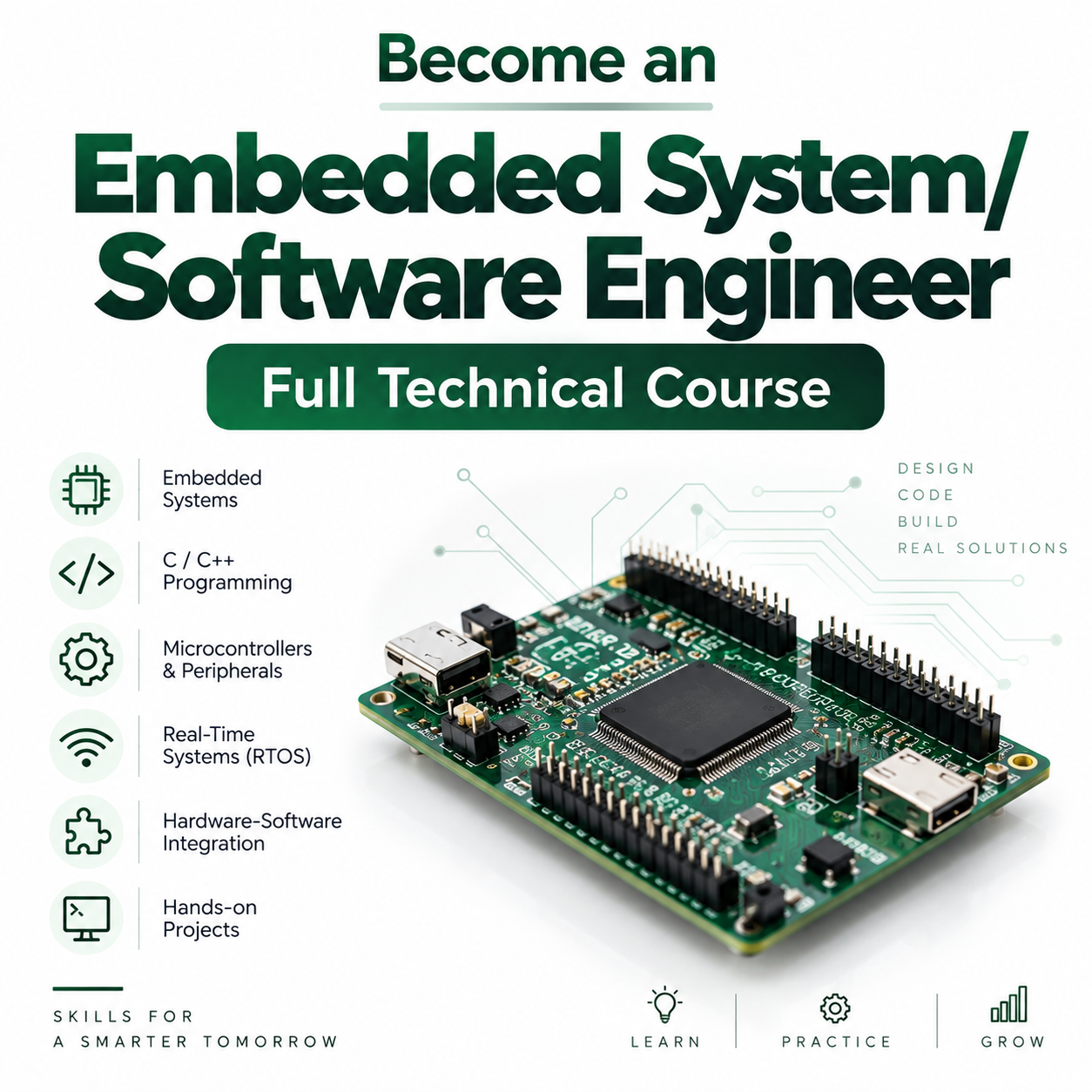
Become an Embedded System or Software Engineer
Full Technical Course — From Fundamentals to Industry-Ready Embedded Development
Build the skills required to start or advance your career in Embedded Systems and Embedded Software Engineering. This comprehensive program takes you from the fundamentals of electronics and computer architecture to Embedded C/C++, microcontrollers, communication protocols, RTOS, Embedded Linux, debugging and real-world software development.
Rather than learning concepts in isolation, you’ll understand how hardware and software work together to build real embedded products used across automotive, robotics, industrial automation, IoT, medical devices and consumer electronics.
Original price was: ₹4,999.00.₹2,999.00Current price is: ₹2,999.00.
Description
What You’ll Learn
- Embedded Systems Fundamentals — Understand embedded systems, CPUs, MCUs, SoCs, memory architecture and how embedded products work.
- Embedded C Programming — Master pointers, memory management, bit manipulation, structures, unions, preprocessor directives and embedded-specific C concepts.
- C++ for Embedded Systems — Learn essential C++ concepts and their practical use in embedded software development.
- Microcontrollers & Peripherals — Understand GPIO, ADC, PWM, timers, interrupts, watchdogs and other common MCU peripherals.
- Communication Protocols — Learn UART, SPI, I²C, CAN and the fundamentals of Ethernet-based communication.
- Real-Time Operating Systems (RTOS) — Explore tasks, scheduling, interrupts, queues, semaphores, mutexes and inter-task communication.
- Embedded Linux Fundamentals — Understand boot processes, Linux architecture, device trees, drivers and the basics of building Linux-based embedded systems.
- Hardware–Software Integration — Learn how embedded software communicates with sensors, actuators, peripherals and external devices.
- Debugging & Development Tools — Work with compilers, build systems, debuggers, Git and common embedded development workflows.
- Software Design & Testing — Learn modular design, coding practices, unit testing, integration testing and software-development lifecycle concepts.
- Hands-on Projects & Practical Examples — Apply concepts through exercises and embedded-system use cases.
- Technical Interview Preparation — Review frequently tested concepts and prepare for Embedded C, C++, MCU, RTOS and embedded-system interviews.
Who Is This Course For?
Ideal for engineering students, fresh graduates, software developers, electronics engineers and professionals looking to transition into Embedded Software Engineering.
It can also provide a strong foundation for moving into specialized areas such as Automotive Software, Robotics, IoT, Embedded Linux, AUTOSAR and Edge Computing.